11 – The importance of secondary streams and their distinctive characteristics
-
description DescriptionOpen Close
Secondary streams are small watercourses, often seasonal or with variable flow, which are distributed across the landscape like a capillary network. Although less visible than the main rivers, they play a fundamental role in maintaining the balance of natural ecosystems.
Their distinctive feature is their ability to connect different habitats: wetlands, woods, meadows and slopes. Through these natural connections, numerous species can move, feed, reproduce and find shelter. For this reason, secondary streams are also referred to as ecological corridors: veritable green bridges that hold the landscape together.
A well-preserved stream is home to a wide variety of life: amphibians, aquatic insects, birds, small mammals and plants that take advantage of the proximity to water to grow and spread. Furthermore, they transport sediments, organic matter and seeds, contributing to soil fertility and water quality.
Streams help circulate water and nutrients between hillsides, plains and wetlands, keeping local ecological processes active.
Did you know that…
The more space we give the river, the less damage it can cause?
Controlled floodplains, such as floodplains, allow water to slow down, spread out and regenerate the landscape, rather than destroy it.
A fine example that combines flood protection with environmental regeneration.
-
image IllustrationsOpen Close
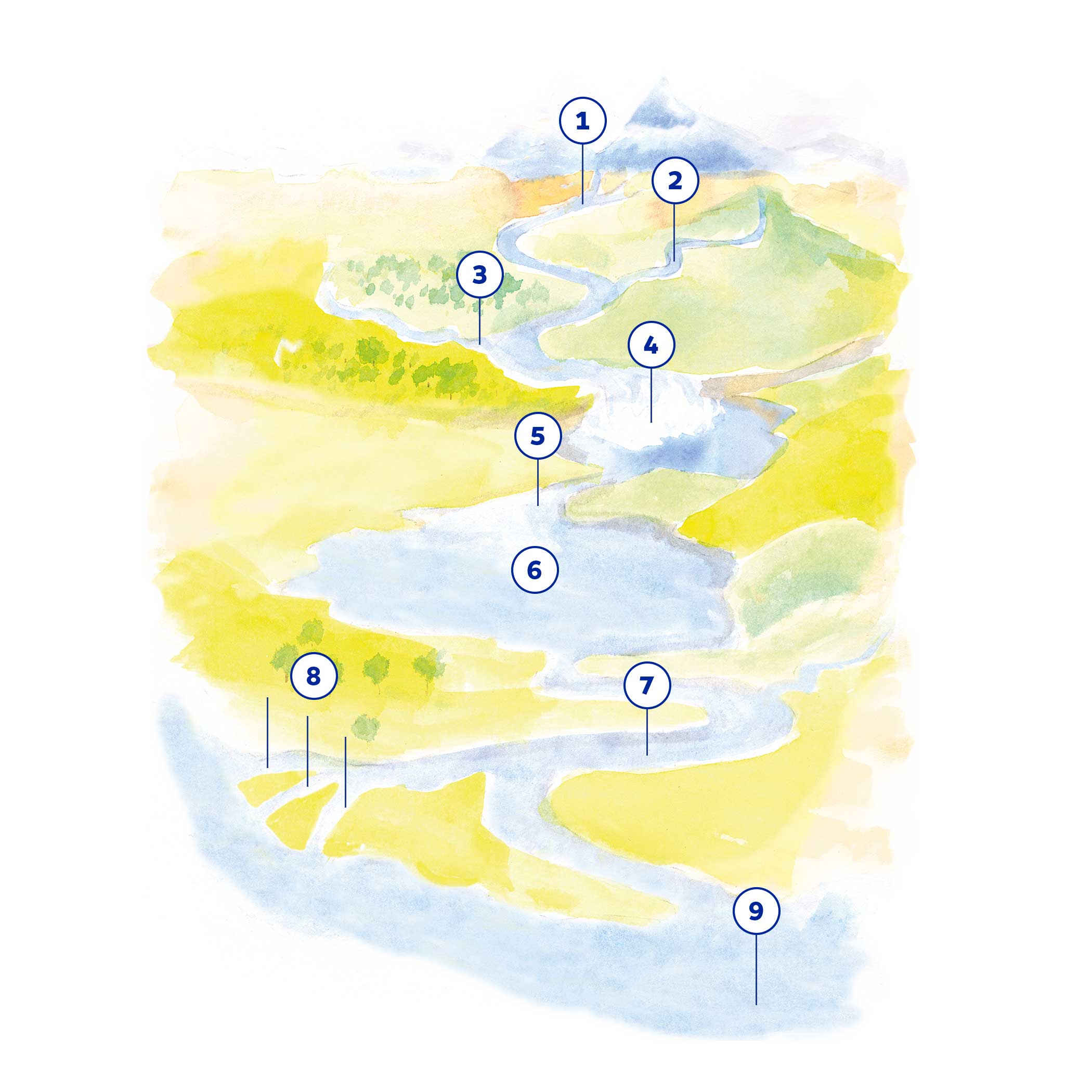
Watercourse typology diagram (1) spring (2) tributary (3) confluence (4) waterfall (5) mouth (6) small lake (7) secondary stream (8) confluences (9) main river

European otter Lutra lutra
-
cards_stack Play along the river